
Publications
Pichia occidentalis volatiles elicit divergent behavioral responses in Drosophila suzukii and Drosophila melanogaster
Ferguson B, Polashock JJ, Hart T, Rodriguez-Saona C, Sun JS. 0. 2026. Appl Environ Microbiol0:e01135-26. DOI: 10.1128/aem.01135-26

Pichia occidentalisDrosophila melanogaster, is shown to selectively deter the invasive fruit pest Drosophila suzukii (spotted wing drosophila). Exposure to P. occidentalis repelled D. suzukii, suppressed female egg laying, and reduced survival, particularly in males, whereas D. melanogaster was attracted to the yeast and laid more eggs in its presence. Volatile profiling and behavioral screening identified several compounds produced by the yeast that repel D. suzukii, three of which outperformed established repellents across a broad range of concentrations, highlighting microbial volatiles as promising tools for targeted pest management that alters insect behavior rather than relying on insecticides. This discovery emerged from an exciting collaboration between undergraduate researcher Tia Hart in the Sun lab at Rutgers, Beth Ferguson and Cesar Rodriguez Saona at NJAES, and James J. Polashock at the USDA.
Escherichia coli Mono-Association Modulates Ionotropic Receptor-Dependent Behaviors in Drosophila melanogaster
Hazem Al Darwish, Mia Cacao, Tia Hart, Deep Patel, Sammi Russo, Safiyah Salama, Muqaddasa Tariq, Aina T. Ananda and Jennifer S. Sun
Insects 2026, 17(3): 275 DOI: 10.3390/insects17030275
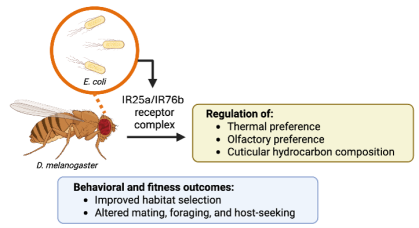
Jennifer S. Sun’s team showed that microbes can actively shape animal behavior. When germ-free fruit flies were colonized with a single bacterium, Escherichia coli, their chemosensory system changed. The flies became more attracted to fermentation-related odors such as vinegar and ethanol, increased their sugar consumption, and displayed altered larval behaviors. These findings demonstrate that microbial status influences what insects seek, avoid, and eat. This work advances our understanding of how microbes can reshape insect neural circuits to influence behavior.
Genome Analysis Reveals Diversity and Functional Potential of Novel Janthinobacterium Species from Subarctic Soils
Anil Kumar, Minna K. Männistö, Lee J. Kerkhof and Max M. Häggblom
MicrobiologyOpen 2026 15(1):e70239 DOI: 10.1002/mbo3.70239

Two novel species of the genus Janthinobacterium of the phylum Pseudomonadota isolated from tundra heath and northern boreal forest soil are described. The species, designated as Janthinobacterium silvisoli sp. nov. and Janthinobacterium saanense sp. nov., are aerobic chemoorganotrophic psychrophiles and are well-adapted to the subarctic climate conditions. The genome-based functional exploration enhances our understanding of this genus and how environmental conditions may shape the functionality and interactions of Janthinobacterium species in subarctic soil ecosystems.